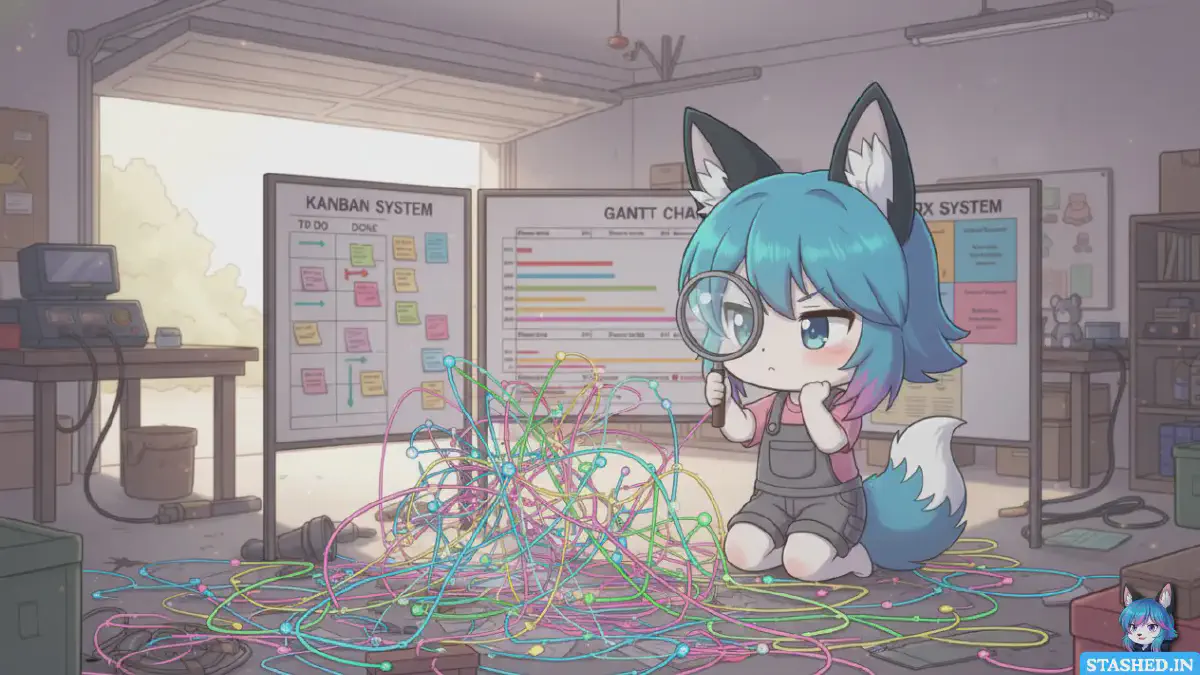
I have 847 saved links in my Notion workspace. I checked this morning. Want to know how many of them I’ve actually referenced in the last three months? Twelve. Maybe fifteen if I’m being generous.
This isn’t a confession about my disorganization (though we could talk about that too). It’s a symptom of a much bigger problem with how knowledge management tools think about links.
Every modern PKM tool (personal knowledge management, for the uninitiated) treats links the same way browsers did in 1995: as simple references that point from here to there. You save a URL, maybe add some tags or put it in a folder, and call it organized. The link sits there, static and disconnected, waiting for you to remember it exists.
But that’s not how your brain works. That’s not how knowledge works. And it’s definitely not how the internet works anymore.
When you save a link, you’re not just capturing a URL. You’re capturing a moment in your thinking process. You’re saying “this matters to me right now, in this context, for this reason.” The link is part of a larger web of ideas, projects, and goals that exist in your head but nowhere in your tools.
Knowledge management tools have gotten incredibly sophisticated about notes. We have bidirectional linking, knowledge graphs, block references, and all sorts of clever ways to connect ideas. But links? They’re still just URLs in a database.
It’s time we rethink what a link actually is and how we should be managing them.
The Problem With How We Currently Save Links#
Let’s start with the obvious: saving links doesn’t work the way we think it does.
You find an interesting article about cognitive load theory. You save it. You add tags like “productivity” and “psychology” and “read-later.” You feel productive. The link joins the hundreds of others in your carefully organized system.
Three weeks later, you’re working on a presentation about team productivity. You vaguely remember that article about cognitive load that would be perfect. But where is it? What did you tag it as? Was it in your “Productivity” folder or your “Psychology” folder? Did you even save it in this tool, or was it in that other app you were trying out?
You spend ten minutes searching. You find three similar articles, none of them the one you wanted. You give up and google it, finding a different article that’s probably less relevant but at least you can access it.
This happens constantly. The effort of saving the link was wasted. The organizational structure you created doesn’t actually help you find things when you need them.
Why? Because the tools treat the link as the end goal instead of the beginning of a relationship between you and that information.
What Links Actually Represent#
Here’s what most knowledge management tools miss: a saved link isn’t just a URL. It’s a connection between information out there on the internet and a specific need, interest, or project in your life.
When you save that article about cognitive load theory, you’re not just saving a URL. You’re making a statement: “This information is relevant to something I’m working on or thinking about.” The link exists in relationship to your other work, your other thoughts, your other saved resources.
But current tools strip away all that context. They reduce the rich, multidimensional relationship between you and that information to a single dimension: the URL itself.
Research on memory and context shows that we remember things better when we can reconstruct the context in which we learned them. The same principle applies to saved links. You’re not going to remember what an article was about based on its title alone. You need context: why you saved it, what you were working on, what problem you were trying to solve.
Most knowledge management tools don’t capture this context, or if they do, they make it so cumbersome that nobody actually does it.
The Illusion of Organization#
Knowledge management enthusiasts (and I say this with love, being one myself) love to build elaborate organizational systems. Nested folders, comprehensive tagging taxonomies, complex databases with multiple views and filters.
These systems look impressive. They feel productive to build. And they almost never work as intended.
The problem isn’t the systems themselves. It’s that they require perfect discipline to maintain and perfect memory to use. You need to remember your exact organizational logic every time you save something and every time you try to find something.
Real life doesn’t work that way. You save things when you’re in the middle of other tasks. You need to find things when you’re under deadline pressure. You can’t spend five minutes deciding which tags to apply or ten minutes reconstructing your folder hierarchy to figure out where past-you would have filed something.
Good knowledge management tools should work with how humans actually think and behave, not require us to become perfect categorization machines.
Why Visual Context Matters More Than We Realize#
Here’s an experiment: close your eyes and try to remember what you had for dinner last Tuesday. Struggling? Now try to remember what the room looked like, who you were with, or what you were watching or talking about. Suddenly, the memory of the meal itself becomes clearer.
Visual and contextual cues are powerful memory triggers. But most knowledge management tools present saved links as plain text in lists or databases. Every link looks identical. There’s no visual differentiation, no contextual anchoring, nothing to help your brain remember what this link was or why it mattered.
This is where thinking about links differently becomes crucial. What if saved links had visual context? What if you could see at a glance what a collection of links was about, not from reading tags or folder names, but from visual cues that your brain processes automatically?
Pinterest figured this out for images. Instead of organizing photos in folders with text labels, they created boards with visual previews. You don’t need to read “Minimalist Interior Design Ideas” to know what’s in the board. You can see it.
The same principle applies to any kind of link. An article, a tool, a video, a resource. Visual context makes collections memorable and usable in ways that text-based organization never can.
The Missing Layer: Context and Connection#
The best knowledge management happens when information connects to other information. That’s why tools like Roam Research and Obsidian focus so heavily on linking between notes. You’re building a web of connected thoughts, not isolated pieces of information.
But this philosophy stops at the boundary of your notes. The links you save from the wider internet? They’re treated as external references, endpoints that don’t connect to anything else.
This creates a weird asymmetry. Inside your knowledge management system, everything connects. Outside your system, you have hundreds of saved links that exist in isolation.
What if links could be first-class citizens in your knowledge system? Not just references you append to notes, but entities that can have their own relationships, contexts, and connections?
This means thinking about links as part of collections that tell stories. A research project isn’t just a note with ten URLs listed at the bottom. It’s a curated collection of resources that build on each other, each contributing to your understanding of the topic.
A design inspiration board isn’t just a list of portfolio sites. It’s a visual exploration of a particular aesthetic or approach, where each link adds to the narrative you’re building.
Links deserve the same respect and organizational sophistication we give to our notes. They’re not secondary artifacts. They’re primary sources of information that need to live within your knowledge system in meaningful ways.
How Different Tools Are Getting It Wrong#
Let’s talk about the current landscape of knowledge management tools and where they fall short with links.
Notion treats links as properties in databases or blocks in pages. Functional, but not particularly useful. Finding a specific link requires remembering which database or page you put it in, and visual differentiation is minimal.
Roam Research and Obsidian treat links as external references. You can link to them from your notes, but they’re not really part of your knowledge graph. They’re just URLs that take you outside your system.
Bookmark managers like Raindrop or Pocket are better at organizing links specifically, but they’re disconnected from your actual knowledge work. They’re storage solutions, not thinking tools.
Browser bookmarks are the worst of all worlds: limited organization, no visual context, no connection to your broader work, and scattered across devices in ways that never quite sync properly.
None of these tools treat links as what they actually are: captured moments of discovery that should integrate seamlessly into your knowledge work.
What a Better Approach Looks Like#
So what would it look like if we actually rethought how knowledge management tools handle links?
First, links need visual context. Not just the URL or title, but something that helps your brain remember what this is and why it matters. Headers, thumbnails, custom images. Something that makes collections of links visually distinct and memorable.
Second, links need to live in meaningful collections, not arbitrary folders. Collections should be project-based, theme-based, or purpose-based. They should reflect how you actually think about and use information, not force you into hierarchical categorization.
Third, links need flexibility in sharing and privacy. Some collections are personal references. Others are resources you want to share with your team. Some are curated recommendations you want to make public. Good tools should support all of these use cases without forcing everything to be one or the other.
Fourth, links need to be accessible across contexts. You save things on your phone, you need them on your laptop. You find something while researching one project, but it turns out to be useful for a different project. Links shouldn’t be trapped in the context where you first saved them.
This is exactly the thinking behind how I built stashed.in. Instead of treating links as dead endpoints, treat them as living parts of your knowledge system. Create visual stashes with image headers that actually convey meaning. Organize by project, interest, or purpose rather than forced hierarchies. Make collections private for personal use, password-protected for team sharing, or public for community contribution.
The link isn’t the end goal. The link is the beginning of integrating external knowledge into your thinking process.
The Social Dimension We’re Missing#
Knowledge management is often framed as a solo activity. Build your second brain, organize your thoughts, capture your ideas. But humans are social learners. We learn better when we can see how other people organize and think about information.
The early web understood this. Delicious let you see what other people were bookmarking. You could follow users with similar interests and discover resources through their curation. It was social bookmarking done right.
Then everything became algorithmic and engagement-driven, and we lost that genuine social dimension of knowledge sharing.
Modern knowledge management tools are almost entirely private. Your Notion workspace is yours. Your Obsidian vault is yours. There’s no native way to say “here’s a collection of resources I found valuable, maybe you will too.”
But knowledge curation is inherently valuable to others. When someone with expertise curates resources on a topic, that curation itself is a form of knowledge. It’s not just the links, it’s the act of selection and organization that provides value.
Good knowledge management tools should support this social dimension without forcing everything to be public or algorithmic. Let people share curated collections when it makes sense. Let others discover those collections when they’re looking for exactly that kind of resource.
Social knowledge management isn’t about going viral or maximizing engagement. It’s about the simple act of saying “I found these resources valuable, they might help you too.”
Why Context Is Everything#
The fundamental problem with how current tools handle links comes down to one word: context.
You save a link because it’s relevant to something specific in your life right now. A project you’re working on. A problem you’re trying to solve. An interest you’re exploring. That context is everything. It’s the reason the link matters. It’s what makes it useful.
But the moment you save that link to a tool that strips away the context, you’ve lost the thread. The link becomes just another URL in a database, indistinguishable from hundreds of others.
Good knowledge management preserves context. It captures not just what you saved, but why you saved it and how it connects to everything else you’re working on.
This is why visual organization matters. An image header on a collection isn’t decoration. It’s contextual anchoring. It’s a reminder of what this collection is about and why these links belong together.
This is why collection-based organization matters. Folders and tags force you to think in hierarchies and categories. Collections let you think in projects and themes, which is how knowledge actually works in your brain.
This is why flexibility matters. Context changes. A link you saved for one project becomes relevant to another project. Good tools let you reorganize and reconnect without friction.
What Happens When Links Become Living Parts of Your System#
When you start treating links as first-class citizens in your knowledge management system, something shifts.
You stop hoarding links because now you actually use them. The friction of finding and referencing saved resources drops dramatically. You’re not searching through databases or trying to remember folder structures. You’re looking at visual collections that make sense.
You start building better resources. Instead of just saving individual links, you curate collections that tell stories. A research project becomes a visual map of everything you’ve found. A learning path becomes a curated sequence of resources that build on each other.
You share more effectively. Instead of sending someone five separate links, you share a curated collection that provides context and structure. They don’t just get the URLs, they get your thinking about how those resources connect.
Your knowledge work becomes more sustainable. You’re not constantly re-finding information you know you saved somewhere. You’re building reusable collections that serve you across multiple projects.
Most importantly, the act of saving a link stops being a dead end and becomes part of your thinking process. You’re not just collecting URLs. You’re building an external knowledge system that actually integrates with how you work and think.
The Technical Challenges Nobody Talks About#
Building better link management isn’t just a design challenge. There are real technical problems that most tools ignore or handle poorly.
Link rot is real. Websites disappear. Content moves. URLs break. Any system for managing links needs to account for this, but most don’t. They just leave you with dead links and no way to recover what was there.
Metadata extraction is unreliable. Tools that try to automatically pull titles, descriptions, and images from links often fail or get garbage data. But manual entry is too much friction. Finding the balance is hard.
Cross-device synchronization is complicated. You save links on your phone, you need them on your laptop. Sounds simple, but building sync that actually works reliably is technically challenging, especially if you want to support offline access.
Privacy and sharing are tricky. You want some collections to be private, some shareable with specific people, some fully public. Managing these different privacy levels while keeping the user experience simple requires careful design.
Visual organization at scale is hard. Pinterest can do it because they control the image aspect ratios and layouts. When you’re dealing with arbitrary web content, creating visually pleasing collections that work across different screen sizes is genuinely difficult.
These aren’t insurmountable challenges, but they’re real problems that knowledge management tools need to solve if they want to handle links properly. Treating links as an afterthought means ignoring these challenges entirely.
What This Means for How You Work#
If you’re reading this, you probably care about knowledge management and productivity. You’ve probably tried multiple tools. You’ve probably built organizational systems that worked for a while and then collapsed.
Here’s what rethinking how we handle links means for your actual workflow:
Stop trying to build perfect organizational hierarchies. They don’t work. Focus instead on creating meaningful collections around projects, interests, and purposes.
Embrace visual organization. Stop forcing yourself to remember what “Research - Q4 2024 - Marketing” contains. Use visual cues that work with how your brain actually functions.
Be more intentional about what you save. Not everything needs to be saved. But what you do save should live in a system that actually helps you use it later.
Think about curation as a skill worth developing. It’s not just about saving links. It’s about organizing information in ways that make it useful and potentially valuable to others.
Use tools that respect how you actually work, not how you think you should work. If you never look at your knowledge management system on weekends, don’t build a system that requires constant maintenance.
Where Knowledge Management Is Heading#
The future of knowledge management isn’t more features. It’s not more complexity. It’s tools that actually understand how humans think and work.
We’re seeing a shift away from trying to capture everything and toward being more intentional about what we save and how we organize it. Quality over quantity. Usefulness over completeness.
We’re seeing more emphasis on visual and spatial organization because that’s how human memory works. Not everyone thinks in outlines and hierarchies. Many people think in spatial relationships and visual patterns.
We’re seeing a recognition that knowledge management needs social dimensions. Not algorithmic social networks, but genuine sharing of curated knowledge between people.
And we’re seeing tools that respect context. That understand a link isn’t just a URL. That knowledge work happens across devices and situations. That privacy and sharing aren’t binary choices.
The tools that will succeed in the next decade won’t be the ones with the most features. They’ll be the ones that make knowledge management feel natural instead of like work.
Building Something Better#
When I started building stashed.in, I was frustrated with exactly the problems this article describes. I had links scattered across bookmark folders, Notion databases, and various “read later” apps. None of them worked the way I actually wanted to work.
I wanted visual collections that I could understand at a glance. I wanted flexibility in sharing without forcing everything to be public or private. I wanted something that worked with how my brain actually organizes information.
But more than that, I wanted to contribute to a shift in how we think about link management as part of knowledge work. Links aren’t secondary artifacts to be dumped in folders. They’re primary sources that deserve thoughtful organization and integration into our knowledge systems.
Every person who creates a well-organized stash is making a tiny statement: links deserve better than they’re getting from current tools. Knowledge management should work with human thinking, not against it.
This isn’t just about building a better bookmarking tool. It’s about rethinking what links are and how they fit into the larger picture of how we capture, organize, and share knowledge.
The Choice In Front of Us#
We’re at an interesting moment in knowledge management. The tools are more sophisticated than ever, but many people feel less organized than they did a decade ago. We have more ways to save information and less clarity about how to actually use it.
The solution isn’t more features or more complexity. It’s rethinking fundamental assumptions about how we handle different types of information.
Links are not secondary to notes. They’re a different type of knowledge artifact that deserves its own thoughtful approach.
Organization is not about building perfect hierarchies. It’s about creating systems that work with how you actually think and remember.
Social sharing is not about algorithms and virality. It’s about genuine curation and the simple human act of saying “this might help you too.”
The tools you choose matter. They shape how you think and work. They either make knowledge management feel natural or like a chore you avoid.
Choose tools that respect links as first-class citizens in your knowledge work. That provide visual context. That offer flexibility in organization and sharing. That work with your brain instead of against it.
The future of knowledge management is being built right now, one saved link at a time. Make yours count.