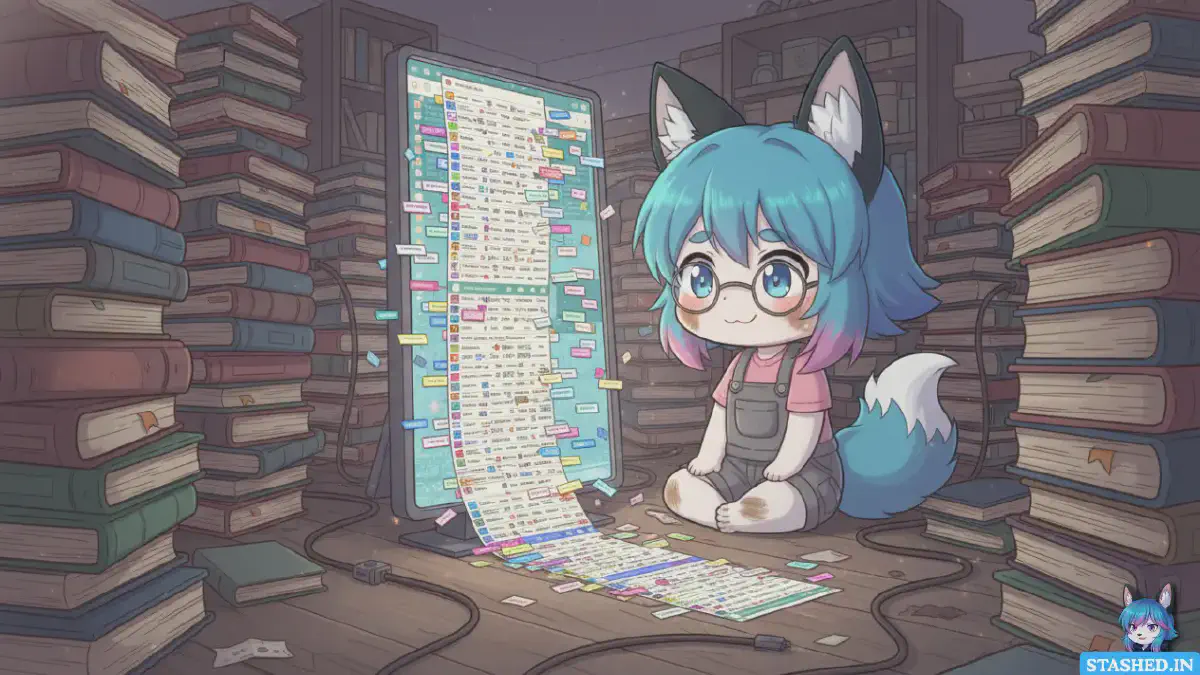
I have a folder in my bookmarks called “Life-Changing.”
It was created in 2018. It has 412 items. I have opened exactly 11 of them more than once.
There’s a 42-minute video on breathwork for anxiety, a $3,000 Notion template for life operating systems, a recipe for sourdough that requires a 10-day starter, and an application page for a writers’ retreat in Bali that ended in 2020.
That folder is not a reading list.
It’s an autobiography.
And if you’re brave enough to open your own bookmark manager right now, yours is too.
The Five Types of Bookmark Personalities I’ve Met (Which One Are You?)#
Over the past two years of running stashed.in, I’ve watched thousands of people import their browser bookmarks. The patterns are scarily consistent.
The Archivist
Bookmarks: 4,000–20,000+
Folder structure: 7 layers deep, named in lowercase with dates
Secret shame: Still has Delicious exports from 2009
Life motto: “I might need this someday”The Tab Zombie
Bookmarks: < 50
Open tabs: 200–900
Uses bookmarks only when Chrome crashes and forces a restore
Believes “tabs are external RAM”The Aesthetic Curator
Everything is in Raindrop.io or stashed.in with custom icons and cover images
Public profile looks like a moodboard
Has never actually reread 94 % of the links
But it’s pretty, okay?The One-Folder Wonder
Single folder titled “Bookmarks Bar” or “Stuff”
800 links in chronological order
Finds things using Ctrl+F like a savage
Surprisingly fast, slightly terrifyingThe Burnout Monk
Zero bookmarks
Uses history search or just re-googles everything
Claims it’s minimalism
(It’s trauma)
I’ve been all five at different points. Right now I’m a recovering Archivist sliding toward Aesthetic Curator.
What Your Forgotten Folders Actually Mean#
Let’s do a quick audit together. Open your bookmarks and look for these folders. I guarantee at least three exist.
“Read Later” / “To Read” / “Important!!!”
Translation: “I feel guilty about not being the kind of person who reads 80 books a year.”“Side Hustle Ideas” / “Business” / “Make Money Online”
Translation: “Capitalism has convinced me that rest is failure.”“Fitness” / “Workouts” / “Health”
Translation: “My body is a todo list I keep ignoring.”“Gift Ideas”
Usually added in November, never opened again until next November.“Inspo” / “Design” / “UI”
Translation: “I want to be the kind of creative who has taste this refined.”“Recipes”
90 % are bookmarked between 11 p.m. and 2 a.m. while hungry.
These aren’t just links. They’re little monuments to aspiration, procrastination, and identity.
The Psychology Behind Bookmark Hoarding#
Saving a link feels like progress. Your brain releases a tiny hit of dopamine — same as completing a task. But unlike actually reading the article or doing the workout, it costs almost zero effort.
Psychologists call this “substitute productivity.” We collect potential instead of building competence.
A 2024 study from the Journal of Consumer Research found that people who maintain large digital collections (bookmarks, Kindle books, Notion pages) report higher levels of anxiety about “not doing enough” than people who keep almost nothing.
The more we save, the worse we feel about not using it.
The Day I Deleted 6,000 Bookmarks#
Last year I exported all my bookmarks, ran a script to remove duplicates, and stared at a CSV with 6,842 rows.
Then I selected all → delete.
For three days I felt phantom limb pain. “But what if I need that one article about sourdough discard crackers?”
Then something wild happened.
I started actually using the internet again.
Instead of hoarding links like a dragon on gold, I began sending them to people. Or stashing them visually on stashed.in where I could find them in 3 seconds flat. Or (radical idea) just reading them immediately.
My attention improved. My anxiety dropped. I finished more things.
Turns out when your future self isn’t buried under 17 years of good intentions, they have room to actually do stuff.
A Better Way: Curate Publicly, Forgive Privately#
Here’s the trick that finally worked for me.
Make your main collections public (or at least shareable).
When a stash on stashed.in might be seen by friends, followers, or future me who cares about reputation, I’m ruthless. I delete the mediocre. I write a one-line note. I pick a header image that makes me smile.
The private stuff? I keep a single stash called “Brain Farts” with zero pressure. It’s password-protected, ugly, and honest. That’s where the 2 a.m. impulse saves go to die peacefully.
This split personality approach — curated public gardens, chaotic private junk drawer — satisfies both my ego and my actual brain.
Your Bookmarks Are a Mirror. What Do You Want to See?#
Next time you catch yourself bookmarking something, pause and ask:
- Will I really open this again?
- If yes, where will I naturally look for it in six months?
- Does this deserve space in the museum of me?
Or just do the nuclear option: export everything, delete it all, and start fresh with one rule.
Only save things you’d be proud to show someone else.
The rest? Let it go.
Your future self rarely wants the crumbs of your past attention. They want clarity.
P.S. If you want to turn your bookmark graveyard into something beautiful (and actually usable), bring them over to stashed.in. I’ll be here with Stasha, judging lovingly as we turn digital chaos into galleries worth sharing.
Now accepting imports from Raindrop, Pocket, Pinboard, and raw browser HTML. Come confess your sins. We’ve seen worse.