I opened 187 tabs last week.
Not in one browser window. Across four browsers, three devices, and two accounts. Some were research for a client, some half-read longreads, a few YouTube videos I swear I’ll watch “when I have time,” and at least 43 shopping carts I’ll never check out.
I’m not proud of it. But I know I’m not alone.
The internet has become a giant jigsaw puzzle dumped on the floor. Every day we pick up new pieces — articles, videos, tools, tweets, Reels, PDFs — and we stuff them wherever there’s space: bookmark folders named “Read Later (2019),” Notion databases with 12 properties nobody fills, Telegram saved messages, iCloud notes titled “IMPORTANT!!!” We promise ourselves we’ll come back and organize everything “this weekend.”
We never do.
And slowly, the things that once excited us get buried under digital sediment. We lose the recipe that changed our cooking game in 2021. We forget the name of that productivity app everyone was raving about in March. We re-google the same things over and over because finding the original source feels impossible.
The internet isn’t getting bigger.
Our ability to hold it together is getting smaller.
Why the Web Feels Broken (Even Though It’s Never Been More Powerful)#
Fifteen years ago, bookmarking felt sufficient. Delicious and Pinboard were enough because the meaningful web was still small. You followed 50 blogs in Google Reader, bookmarked the best posts, and life was good.
Then the firehose turned on.
Today the average knowledge worker is exposed to more information in a single day than a 19th-century person saw in a lifetime. Social algorithms reward novelty over depth. Platforms actively punish external links (good luck getting reach if you send people off-site). The result?
We consume in isolation and store in silos.
- Twitter thread → saved to Twitter
- YouTube video → Watch Later (which nobody watches)
- Newsletter link → saved to Pocket/Instapaper/Raindrop/Omnivore
- Random WhatsApp forward → Telegram Saved Messages
- Work document → Notion / Google Drive / Slack thread
Each silo has its own search, its own login, its own export format. Nothing talks to anything else. The context you had when you saved the link evaporates the moment you need it six months later.
This is digital fragmentation — and it’s the silent productivity killer of our era.
The Real Cost of a Fragmented Internet#
It’s not just annoying. It’s expensive.
Decision fatigue
Every time you think “I saw something about this once…” you lose 5–30 minutes hunting across platforms.Duplicate effort
You bookmark the same article in three different tools because you don’t trust any single one.Lost opportunities
That perfect thread on indie-hacking monetization? Buried. That UI pattern you loved? Gone. That job post your friend sent? Deleted itself from chat after 30 days.Cognitive load
Knowing you have chaos “somewhere” creates background anxiety even when you’re not working.
A 2023 study from the University of California found that “context switching between information sources” costs the average worker 23 minutes of deep focus each time.” Do that ten times a day and you’ve burned almost four hours — on nothing.
We Don’t Need Another Fancy Tool. We Need a New Behavior.#
Most attempts to fix this problem throw technology at it: AI-powered second brains, auto-tagging, smart folders, graph views. They’re beautiful. They’re also overwhelming. The paradox of modern PKM (personal knowledge management) tools is that the more powerful they become, the higher the setup cost and the more likely you are to abandon them.
I’ve tried them all. Roam, Obsidian, Logseq, Capacities, Anytype, Mem, Reflect. I still have the export folders to prove it.
What actually works is brutal simplicity + visual memory + social friction.
Let me explain.
Humans are visual creatures. We remember spaces and images far better than we remember text strings. That’s why Pinterest grew to half a billion users with almost no marketing — people instinctively understand boards of images.
We are also social creatures. When something is purely private, we deprioritize it. When there’s even the possibility of someone else seeing it, we care a little more. We polish. We organize. We come back.
And we are lazy creatures. If saving something takes more than two clicks and zero thought, we won’t do it consistently.
Pinterest for Links: The Pattern That Should Have Won#
Think about how you use Pinterest:
- You see a beautiful kitchen → one click save → choose (or create) a board → done.
- Six months later you think “modern minimalist kitchen” → open Pinterest → instantly see the image → click through.
Zero tagging. Zero folders inside folders. Just a big visual grid that your brain parses in milliseconds.
Now imagine that exact flow… but for every link on the internet.
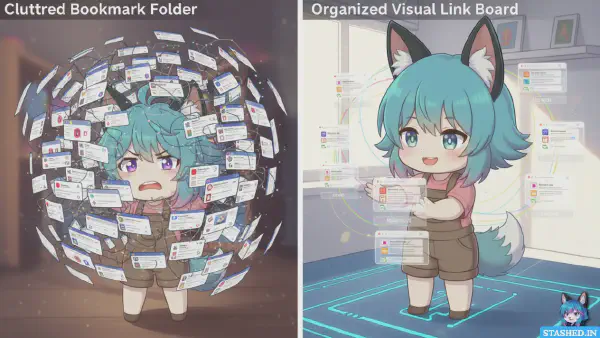
No more “which app did I save this in?” No more 2,000-item Read Later graveyard. No more praying that Pocket’s search understands your brain.
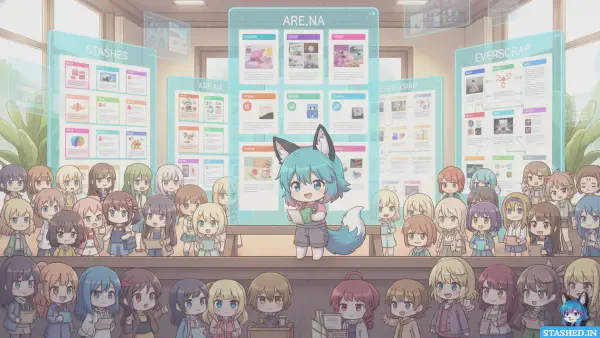
Just stashes of links with beautiful header images, arranged exactly how you think.
Public, private, or password-protected. Shareable with one link. Zero learning curve.
That’s why I built stashed.in two years ago.
How stashed.in Actually Fixes Fragmentation (Without Feeling Like Work)#
I won’t pretend it’s magic. It’s deliberately simple.
When you find something you want to keep:
- Click the share button on mobile or the bookmarklet on desktop
- Pick (or create) a stash
- Optional: change the header image to whatever helps you remember (screenshot, mood image, or auto-generated)
- Done
That’s it.
Later, when your friend asks for book recommendations, you open your “Books That Rewired My Brain” stash and send one link. They see a gorgeous visual board, not a bare list.
When you’re researching Notion alternatives for the third time this year, you open your “Productivity Tools Graveyard” stash and everything is exactly where you left it.
When you want to keep something completely private, you mark the stash private. When you want to share a secret moodboard with your partner, you password-protect it. When you want the world to see your taste, you leave it public.
Because stashes are visual and shareable, you actually maintain them. My personal account has 87 stashes and I can find anything in under ten seconds. No AI required.
The Surprising Side Effect: You Start Curating Instead of Hoarding#
Here’s what nobody talks about: when saving becomes visual and social, your standards go up.
A bare bookmark list invites chaos — who cares, nobody sees it. A beautiful stash that your friends might browse? You think twice before throwing in low-quality junk.
Over time you move from hoarding to curating. You delete the mediocre. You write short notes. You arrange in deliberate order.
Your second brain stops looking like a landfill and starts looking like a gallery.
Is This the Final Answer? Of Course Not.#
Stashed.in doesn’t replace your note-taking apps. I still use Apple Notes for fleeting thoughts and Obsidian for interconnected writing. But 90 % of the links I used to lose now live in stashes where I can actually find them again.
We don’t have an extension yet (it’s the #1 feature request, we’re working on it). For now the share sheet and bookmarklet are enough for me — and apparently for the 18,000+ people who’ve made over 400,000 stashes since launch.
Bringing the Internet Back Together — One Stash at a Time#
The open web isn’t dying because of paywalls or algorithms.
It’s dying because we stopped having shared places to put the things we love.
We retreated into private silos and called it productivity.
Maybe the fix isn’t another blockbuster app with 400 features.
Maybe it’s a return to something simpler: beautiful, visual, lightly social collections that make you proud to share what you’ve found.
If that sounds like something you’ve been missing, come play.
Create a stash called “Internet Fragments I Refuse to Lose.” Throw three links in. Pick pretty headers. Send it to a friend.
See how it feels when your corner of the web starts feeling whole again.
I’ll be here, turning my 187 tabs into something worth keeping.
→ stashed.in
(And if you make something beautiful, tag me. Stasha and I love seeing what people build.)