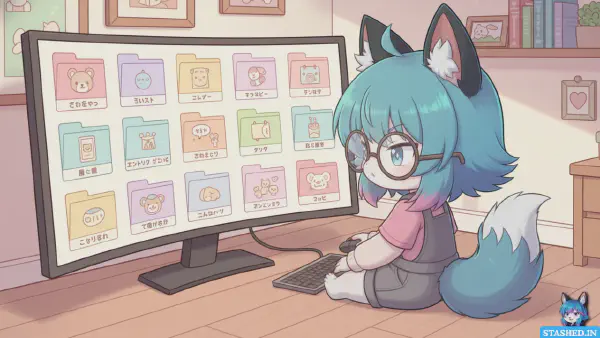

There was a time when your bookmark bar said everything about you.
A row of tiny favicons perched neatly under the address bar, productivity tools, favorite blogs, maybe a guilty pleasure or two. It was personal, practical, and oddly intimate.
But look around now. The modern web has outgrown it. Most of us don’t even glance at that little strip anymore. It sits there like a relic from a different era - static, lifeless, almost nostalgic.
The truth is simple: the bookmark bar is dying. And it deserves to.
A System That Stopped Evolving#
The bookmark bar was born in the early days of the web, when online life was simple. You visited a handful of sites regularly, and saving them in a fixed strip made sense.
Back then, the web was smaller, slower, more predictable. You had your daily destinations - news, email, maybe a forum, and the bookmark bar was your personal control panel.
But that model broke the moment the web exploded into infinity.
Today, we don’t “visit” sites. We jump between articles, threads, videos, tools, and communities across dozens of tabs. Our attention isn’t linear anymore, it’s fractal.
The bookmark bar, frozen in its early-2000s simplicity, just can’t keep up with that complexity.
It’s the digital equivalent of organizing your music with cassette tapes while everyone else streams playlists.
The Real Problem: Static Tools in a Dynamic World#
Bookmarks never evolved past being static pointers to static places. They remember where you went, but not why you went there.
And that’s the fundamental problem.
When you click “Save,” your browser doesn’t capture the context, what you were researching, what idea it sparked, or why it mattered to you at that moment.
A link alone is meaningless. Context is what gives it life.
So while your bookmark bar can hold thousands of links, it can’t hold meaning. It becomes a pile of disconnected coordinates, impossible to navigate once your brain moves on.
We’ve all been there: scrolling through old bookmarks and realizing we don’t even remember what half of them are.
That’s not a storage problem. It’s a design flaw.
The Modern Web Runs on Discovery, Not Storage#
Today’s web thrives on surfacing, not saving.
Algorithms suggest, communities share, feeds evolve. Everything finds you instead of the other way around.
Saving links used to feel like control. Now it feels redundant. If you want to revisit something, the web will show it to you again, or someone else will rediscover it for you.
But there’s a downside to that: we’ve traded ownership for convenience.
The old bookmark bar was yours. Your taste, your judgment, your hand-curated list of what mattered.
Now, your digital diet is shaped by what algorithms think you’ll like. You consume, but you don’t curate.
And in losing that habit of intentional saving, we’ve lost something subtle but powerful — the act of building a personal web inside the larger one.
The New Need: Personal Knowledge Systems#
The death of the bookmark bar doesn’t mean we stop saving, it means we need to save differently.
The modern web user isn’t looking for a static bar of links. They’re building living collections of ideas. They’re researching, learning, connecting dots.
Your saved links shouldn’t just sit there; they should work for you.
They should organize themselves, remember context, show previews, and evolve with you.
They should function less like a filing cabinet and more like a second brain -> a network of your thoughts, inspirations, and discoveries.
That’s the philosophy behind new-generation link tools like stashed.in.
Instead of a rigid list, you create stashes, dynamic collections of links that grow organically around themes, moods, or goals. Each stash feels alive: you can tag, visualize, or share it without ever feeling trapped in folder logic.
It’s what the bookmark bar should have become, personal, intelligent, visual, and effortless.
The Rise of the “Personal Web”#
We’re entering a post-browser era where your personal web becomes more important than your public web.
Everyone’s internet looks different now. Algorithms, interests, and communities shape each user’s experience uniquely. But the infrastructure for saving and recalling personal web data hasn’t kept up.
We need systems that adapt to us.
Imagine opening your browser and seeing not a bar of icons, but a living dashboard of what you’ve been thinking about, your ongoing projects, your inspirations, your research threads.
That’s not science fiction. It’s simply the next step in digital evolution, from storing links to mapping knowledge.
Why Simplicity Wins Again#
The future of saving doesn’t belong to bloated productivity apps or complex note-taking systems. It belongs to tools that bring simplicity back to the experience without stripping away intelligence.
Minimal, visual, context-aware. That’s the direction we’re heading.
A system that respects your attention instead of fragmenting it.
When you use something like stashed.in, it’s not about managing links anymore, it’s about reclaiming your focus. It’s a quiet rebellion against the noise. You’re not bookmarking the web; you’re designing your own version of it.
The Emotional Side of Letting Go#
There’s something sentimental about the old bookmark bar. It feels like closing a chapter of the early web, that personal, hand-built internet where you had to know your way around.
But letting it go doesn’t mean losing that intimacy. It means evolving it.
The personal web can still be handcrafted, still be yours. It just lives in a smarter container now. One that grows with you instead of trapping you in outdated structures.
The next generation of digital minimalists won’t have bookmark bars. They’ll have link ecosystems, tools that quietly organize and contextualize their online lives so they can focus on what really matters: creating, learning, thinking.
The End of the Bar, the Beginning of a Network#
The bookmark bar is dying not because we stopped saving, but because we started thinking differently.
The web isn’t a set of destinations anymore. It’s a living map of ideas.
Our tools should reflect that, they should move with us, learn with us, and help us turn what we discover into something meaningful.
In a sense, the bookmark bar isn’t dying at all. It’s just evolving into something smarter, more human, and infinitely more creative.
And if the next generation of the web is about building personal networks of thought instead of static bars of links, then tools like stashed.in aren’t just useful, they’re the logical next step in how we think online.
So yes, the bookmark bar is dead.
But the personal web is just getting started.